

Overview #
I’ve always been drawn to the concept of a Universe of Ideas — separate from the physical universe we can touch and measure. Unlike the physical one, the universe of ideas doesn’t have to follow strict laws. You can think of something completely absurd, something that could never exist physically, and it still lives there because you can conceive of it. It is where gods, spirits, tale stories, math, dreams live.
Animal brains, especially human ones, are what let us explore this second universe. And just like in an RTS game where the map starts hidden under a fog of war that you slowly uncover as you explore, I think of that fog as the Sea of Ignorance. As we explore the universe of ideas, we push the sea of ignorance back, little by little.
The tricky part is that our brains have limited memory and compute. We can’t hold the whole thing in our heads at once. The best tool I can think of for navigating it is a mental map, something navigable that shows you where things are, how they connect, and how much is still out there beyond what you know.
I started applying this idea to mathematics, which I’ve been interested in since I was little. But I’d like to go much further, building a mental map of the entire known universe of ideas, where the math map would just be one small part.
(Below paragraphs are generated by AVA)
Map of Mathematics #
An atlas that tries to show the entire field as a single interconnected territory, where every theorem and concept traces back to its foundational axioms.
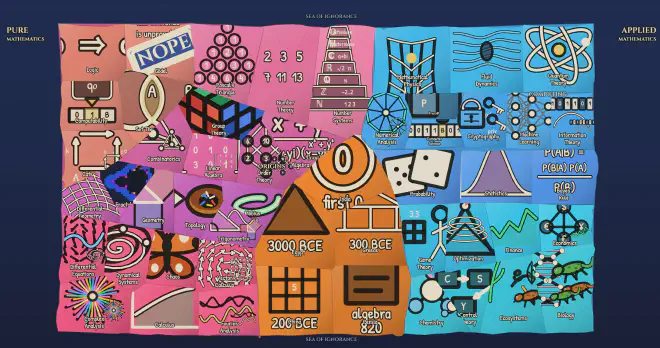
The goal is something similar in spirit to Dominic Walliman’s Domain of Science poster, but interactive, exhaustive, and honest about the dependency structure of ideas. You can zoom into any region, click a topic to inspect its prerequisites and the concepts that build on top of it, and follow curated paths from axioms all the way to frontier results like Fermat’s Last Theorem or the Navier–Stokes equations.
What it looks like #
The map is rendered as an island — a political-map-style continent divided into named countries, one per mathematical domain (Number Theory, Topology, Differential Equations, Logic, Probability, and so on). Countries cluster into continents by family: Foundations, Algebra, Analysis, Geometry, Applied Mathematics. The sea surrounding the island is labelled Sea of Ignorance, a nod to how much mathematics still lies beyond the mapped horizon.
Each country is filled with terrain icons — a visual vocabulary of objects from that field. Hover or click any topic to open the inspector card, which shows:
- The path from a root axiom down to that topic
- Its prerequisites — everything you need to understand first
- The topics directly below — the concepts it unlocks
Data sources and inspiration #
The underlying tree of ~900 nodes is assembled from the MSC2020 Mathematics Subject Classification — the canonical classification used by Mathematical Reviews and Zentralblatt MATH, covering every active area of research mathematics. That skeleton was enriched with conceptual prerequisite links, curated walks (guided paths through the tree), and coverage data.
The visual design is directly inspired by Dominic Walliman’s Map of Mathematics poster, aiming to match its encyclopedic density and the sense that you are looking at a coherent intellectual landscape, not just a list.
This is a work in progress #
Planned improvements include:
- Denser data — more leaf nodes, especially in applied and computational areas (numerical analysis, combinatorics, mathematical physics)
- Better prerequisite links — the current graph has ~900 nodes but the edges are still being refined; some paths are too shallow
- Mobile layout — the canvas works on desktop; a responsive layout for smaller screens is needed
- Search improvements — fuzzy search, search-by-domain filter, and keyboard navigation
- Guided tours — curated walks that tell a story (e.g. The road to Gödel’s incompleteness theorems)
- Export — high-resolution poster export from the canvas
You can explore it at mathmap.afonsosoares.com.